I think I really am an ideologue. I think I have been driven in a fashion often obsessive and sometimes unbalanced by the need to better the world, to eradicate injustice, to challenge the liberal premise.
Stephen Lewis, May 1987
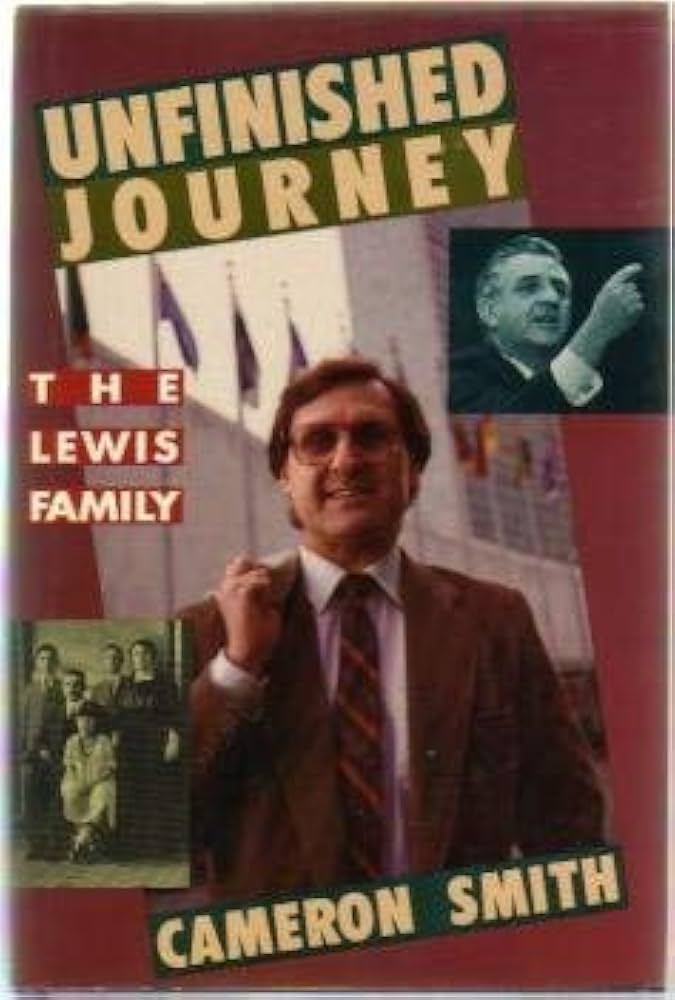
Summerhill Press, Toronto. 1989. ISBN: 9780929091044
From the dust jacket, 1989: Unfinished Journey spans two Russian revolutions and two World Wars, moving from the shtetls of Eastern Europe to the immigrant Jewish neighbourhoods of Montreal, from Oxford between the wars to northern Canadian mining communities in the 1940s, right up to the current national political scene. Cameron Smith has placed the lives of the Lewis
family in the vivid context of world history, from the rising revolution in Russia in the late 19th century, to the African famines of the 1980’s. Whether fighting Bolsheviks in Svisloch, communities in the North American trade union movement, or the ultra-left Waffle group in the NDP in the 1970’s, he traces the continuing commitment to democratic socialism of all three Lewis generations.
Excerpt from Chapter One:
The Bolsheviks wanted peace with Poland. They needed peace with Poland. After the withdrawal of the German army, Polish forces had taken up positions far to the east of the old, pre-war border, which found them, at the end of 1919, about 175 kilometres west of Kiev. Several times the Bolsheviks proposed negotiations but each time the Poles found a way to avoid them. Then, on April 25, 1920, the Poles attacked, sweeping into Kiev on May 6. Poland proper was jubilant. At last the old boundaries were restored to what they had been 148 years ago before Poland was carved up by land-hungry Russians and Prussians.
It was a short-lived, indeed a foolish, jubilation, for out of the east, thundering across the plains of Ukraine from its position just beyond the Sea of Azov, came Budenny’s fearsome Cavalry Army: 16,700 mounted men, forty-eight cannon, five armoured trains, eight armoured cars, and twelve aircraft rushing to join the Bolshevik forces already in place. And in the north, one week after the fall of Kiev, the man whom Stalin would come to call “the demon of the Civil War,” Tukhachevsky, the twenty-seven-year-old aristocrat-turned-revolutionary, commander of the Soviet Western Front, threw his armies at the Polish lines.
Tiny Svisloch, about 300 kilometres on the other side of the those lines, lay on Tukhachervsky’s direct path to Warsaw. An old market town of about 4,500, of which 3,500 were Jewish, it lay east of Bialystok and south of Grodno at about the same latitude as Prince Albert in Canada, Nottingham in Britain, and Bremen in West Germany. On today’s maps it is in the Soviet Union about seventeen kilometres from the Polish Border. In July 1920 the town was still recovering from the German invasion of the First World War: from 1915 to 1918 it had been occupied by German troops. David Lewis would recall in his memoirs that:
I was barely six [when] our area was occupied by the advancing German army. When fighting came close, we scrambled into a big cellar with many other families…We shared the food and slept in each other’s laps, as it were, for several nights…A sound like thunder was heard for hours, but I could not see any rain through the one little window…Then the thunder retreated and we came out into the daylight. The very first sight was unnerving. On the streets and in the market square lay men in pools of blood. Some, I was told, were badly wounded, others were dead. Fearfully I asked my father whether they were Russian or German. “Both,” he answered and I was bewildered. I couldn’t tell the difference.”
[End of excerpt.]